Brazilian Test Apparatus About
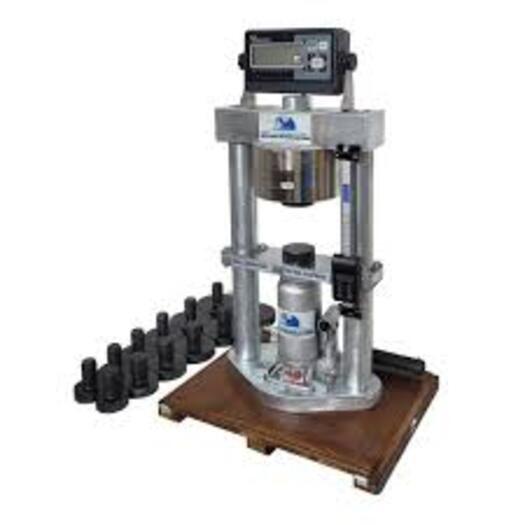
We offer a precision-engineered Brazilian Test Apparatus, designed for determining the indirect tensile strength of rock, concrete, and cylindrical specimens. The apparatus is widely used in geotechnical, civil engineering, mining, and material testing laboratories.
The test is based on the Brazilian splitting method, where a compressive load is applied diametrically to a cylindrical specimen until failure occurs, allowing calculation of tensile strength.
Key Features
- Heavy-duty rigid loading frame
- Hardened steel loading platens
- Compatible with rock and concrete core samples
- Hydraulic or manual loading system (model dependent)
- Accurate load application and uniform stress distribution
- Digital load gauge / pressure gauge (optional)
- Corrosion-resistant structure
- Easy specimen placement and operation
Applications
- Rock mechanics testing
- Concrete tensile strength testing
- Civil engineering laboratories
- Mining and geotechnical investigations
- Material research and quality control
Working Principle
The Brazilian Test (Indirect Tensile Test) applies a compressive load along the diameter of a cylindrical specimen. This induces tensile stress perpendicular to the load direction, causing the specimen to split. The failure load is used to calculate tensile strength.
Advantages
- Simple and reliable testing method
- Suitable for brittle materials
- High accuracy and repeatability
- Easy operation and low maintenance
- Widely accepted standard test method
Reliable Precision and SafetyEngineered with a strong mild steel frame and an anti-corrosive, powder-coated finish, the Brazilian Test Apparatus provides dependable mechanical testing for rocks and concrete specimens. Safety is integral, with overload protection, a durable safety cover, and replaceable hardened steel platens ensuring secure and reliable operation throughout each test.
Versatile Operation and Data ManagementThe apparatus supports both manual and motorized control modes (depending on model), making it adaptable for a range of laboratory and field environments. Digital models feature a USB port for seamless data logging, and all units come with tools, spares, and an initial calibration certificate, providing convenience and compliance.
Compliance and Performance AssuranceConforming to IS:10082 and ASTM D3967, the apparatus guarantees results that align with industry best practices. With an accurate strain gauge load cell, up to 200 kN test range, and resolution down to 0.01 kN, users benefit from high-precision tensile strength measurements essential for material research and quality control.
FAQ's of Brazilian Test Apparatus:
Q: How do you operate the Brazilian Test Apparatus for tensile strength measurement?
A: Specify the appropriate control mode (manual or motorized), mount a single cylindrical specimen (50 mm diameter x 100 mm length) between the hardened steel platens, set the desired test speed (0.5 mm/min to 5 mm/min), and initiate the test. The apparatus will apply a uniform load, recording data through its digital or analog display.
Q: What is the benefit of the strain gauge-based load cell in this apparatus?
A: The strain gauge-based load cell ensures high-precision measurement of applied force, delivering a test accuracy within 1% and a resolution of 0.01 kN. This precision is crucial for dependable tensile strength analysis in material testing.
Q: When should I use the Brazilian Test Apparatus?
A: Use the Brazilian Test Apparatus when you need to determine the indirect tensile strength of rock, concrete, or similar cylindrical specimens, whether for research, quality control, or field evaluation. Its robust design makes it suitable for both laboratory and on-site testing.
Q: Where is the Brazilian Test Apparatus typically installed and used?
A: This apparatus is commonly installed on a bench-top in laboratories or at field testing locations. Its compact design and power requirements (220-240V AC, 50 Hz) make it suitable for a variety of material testing environments in India and abroad.
Q: What safety features are included in the Brazilian Test Apparatus?
A: Safety is ensured by overload protection mechanisms, a durable safety cover, and the use of replaceable, hardened steel platens. These features protect both the operator and the machine during high-stress testing procedures.
Q: How does data output and calibration work on digital models?
A: Digital models include a USB port, enabling data to be logged directly for analysis or record-keeping. Each apparatus is supplied with an initial calibration certificate for assurance of measurement accuracy right from installation.
Q: What accessories are included with the Brazilian Test Apparatus?
A: Each unit comes equipped with a full set of tools and spares to facilitate installation, ongoing maintenance, and routine adjustments, ensuring optimal performance and longevity.

 Send Inquiry



 Send Inquiry


 Send Inquiry