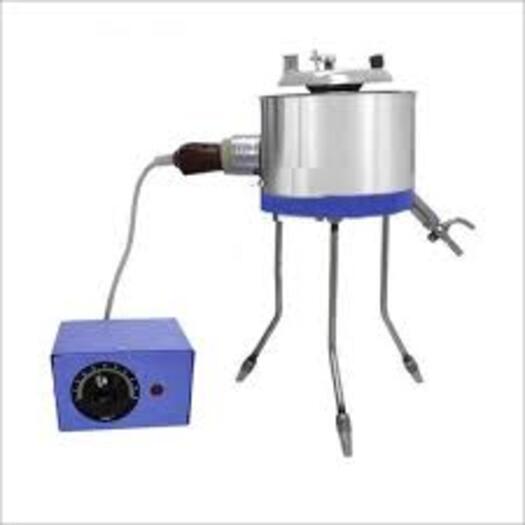
Standard Tar Viscometer About
Key Features
- Chrome-plated copper or stainless steel bath
- Electrical heating with thermostat/dimmer control
- Standard orifice cups (2 mm, 4 mm, 10 mm)
- Ball valve arrangement for flow control
- Stirrer with insulated handle for uniform temperature
- Mounted on stand with leveling screws
Technical Specifications
- Material: Copper bath / Mild Steel / Stainless Steel
- Temperature Range: Up to 45C (with thermometer)
- Power: Approx. 300 W
- Power Supply: 220230V, 50 Hz
- Standards: IS:1206, IP 72, BS:2000
- Operation: Manual / Semi-digital / Digital
Applications
- Bitumen and asphalt testing laboratories
- Road construction and highway projects
- Petroleum and oil testing labs
- Civil engineering colleges and research institutes
Working Principle
The sample is heated in a controlled bath and allowed to flow through a standard orifice cup. The efflux time (in seconds) is recorded, which directly indicates the viscosity of the material.
Precision in Viscosity MeasurementSupporting both IS: 1206 - 1978 and ASTM D2393 standards, this viscometer ensures high accuracy in determining the flow characteristics of tar, bitumen, and asphalt samples. Its sturdy brass and copper construction, coupled with a corrosion-resistant finish, upholds long-term reliability under rigorous laboratory environments.
User-Friendly Operation and AccessoriesDesigned for bench-top use, the viscometer features a manual stirring mechanism, a conveniently adjustable energy regulator, and a clear provision for thermometer placement. The set includes all necessary accessories - receiving flask, two thermometers, and a support stand - enabling seamless test execution from set-up to results collection.
Optimal Heating and Temperature ControlEquipped with a 10-liter water bath and a 500 W electric heating element, the instrument assures uniform temperature distribution. The energy regulator permits precise control, while the thermometer provision assists in maintaining and monitoring exact test conditions, which is essential for reproducible viscosity readings.
FAQ's of Standard Tar Viscometer:
Q: How is the Standard Tar Viscometer operated during viscosity testing?
A: The viscometer is designed for manual operation, featuring a bench-top mounting and a manual stirrer. Samples are introduced into the 10 mm orifice cup, and the heating element is adjusted with the energy regulator to maintain the required water bath temperature. The flow time is then measured using the included accessories.
Q: What types of materials can be tested using this viscometer?
A: This instrument is suitable for testing the viscosity of road tar, bitumen, and asphalt samples in accordance with IS: 1206 - 1978 and ASTM D2393 standards. It is primarily used in laboratory settings for materials used in road construction and similar applications.
Q: When should the water bath temperature be adjusted, and how is it monitored?
A: The water bath temperature should be set prior to beginning any test to ensure accurate viscosity readings. The included thermometers and energy regulator enable precise temperature adjustment and monitoring throughout the testing process, supporting consistent results.
Q: Where can this viscometer be utilized, and what is the recommended ambient temperature?
A: The Standard Tar Viscometer is intended for use in laboratory environments. It functions optimally at ambient temperatures up to 50C, making it suitable for most standard laboratory or industrial test settings.
Q: What is the process of measuring viscosity with this viscometer?
A: A measured quantity of tar or bitumen sample is introduced into the cup. The sample is maintained at specified temperatures using the water bath. With the manual stirrer ensuring uniform temperature distribution, the time taken for the sample to flow through the 10 mm orifice is measured, determining its viscosity.
Q: What are the benefits of using this model over others?
A: This viscometer provides robust construction, consistent temperature control, and adherence to recognized standards. Its corrosion-resistant finish and comprehensive accessory set make it ideal for repeated, accurate laboratory testing, contributing to the reliability of road material assessments.

 Send Inquiry



 Send Inquiry


 Send Inquiry