Ductility Testing Machine About
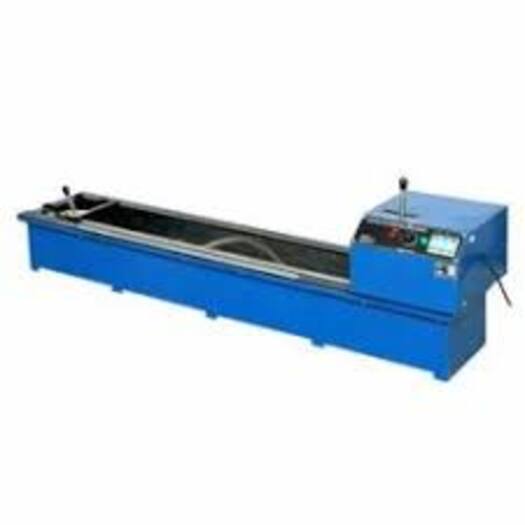
Ductility Testing Machine is a precision laboratory instrument used to determine the ductility (elongation property) of bituminous materials. The test measures the distance in centimeters to which a standard briquette of bitumen can be stretched before breaking under specified conditions of temperature and speed.
The apparatus consists of a water bath with thermostatic temperature control, a motor-driven carriage, briquette mould holders, and a calibrated scale. The sample is pulled apart at a constant speed (typically 50 mm/min) while maintained at a controlled temperature (usually 2527C) to ensure accurate and repeatable results.
It is widely used in civil engineering laboratories, highway construction projects, research institutes, and quality control labs for evaluating the flexibility and binding properties of bitumen.
Key Features
- Motorized carriage with constant pulling speed
- Thermostatically controlled water bath
- Stainless steel inner tank for durability
- Simultaneous testing of up to 3 specimens
- Digital or analog temperature control options
- High accuracy and repeatability
Technical Specifications
- Speed: 50 mm/min (standard)
- Temperature Range: 5C to 30C (with cooling option)
- Specimen Capacity: 3 samples (standard models)
- Power Supply: 220230V AC, 50 Hz
- Material: Mild steel body with SS tank
- Standards: ASTM D113, IS 1208, AASHTO T51, EN 13398
Applications
- Determination of ductility of bitumen and asphalt
- Road construction and pavement design testing
- Quality control in highway projects
- Research and educational laboratories
Working Principle
A molded bitumen specimen (briquette) is placed in the machine and immersed in a temperature-controlled water bath. The two ends are pulled apart at a constant speed until the sample breaks. The elongation distance at the breaking point is recorded as the ductility value.
High-Precision Testing for Asphalt DuctilityThe Ductility Testing Machine offers precise measurement of bitumen and asphalt elongation, meeting both IS 1208 and ASTM D113 standards. Its microprocessor controls and steady pulling speed deliver reproducible results, essential for quality assurance in road construction and research laboratories.
Robust Construction and User-Friendly FeaturesConstructed with a stainless steel inner tank and powder-coated mild steel body, this machine is built for durability and ease of maintenance. The unit features a digital or analog scale for clear readings, along with both manual and automatic operating modes to suit varied testing needs.
FAQ's of Ductility Testing Machine:
Q: How does the Ductility Testing Machine work?
A: The machine stretches a bituminous specimen submerged in a thermostatically controlled water bath at a constant rate (either 50 mm/min or 2.5 mm/min). The elongation at which the specimen breaks is digitally or analogously displayed as ductility in centimeters.
Q: What types of materials can be tested using this ductility tester?
A: This machine is specifically designed to test the ductility of bituminous materials, such as asphalt and bitumen, commonly used in road construction and pavement industries.
Q: When should ductility testing be performed in the laboratory?
A: Ductility testing is typically performed during quality control of asphalt mixes or raw bitumen, and whenever conformance with national (IS 1208) or international (ASTM D113) standards is required.
Q: Where is the Ductility Testing Machine most commonly used?
A: It is commonly used in research laboratories, quality control labs of asphalt manufacturers, road construction companies, and academic institutions involved in materials testing.
Q: What is the process for conducting a test with this equipment?
A: To conduct a test, three specimens are placed in the molds, set in the water bath, and stretched at a controlled speed until rupture. Temperature and speed settings are adjusted as required, and the ductility is read from the digital or analog display.
Q: How does temperature control benefit ductility testing?
A: Precise temperature control via a thermostatically controlled water bath ensures standardization and reproducibility of results, as ductility values are highly temperature-sensitive.
Q: What are the key advantages of this ductility tester for laboratories?
A: Main advantages include its compliance with international standards, accurate microprocessor control, robust construction, easy maintenance, multiple specimen capacity, and both manual and automatic operation.

 Send Inquiry



 Send Inquiry


 Send Inquiry