About Hot Mounting Press
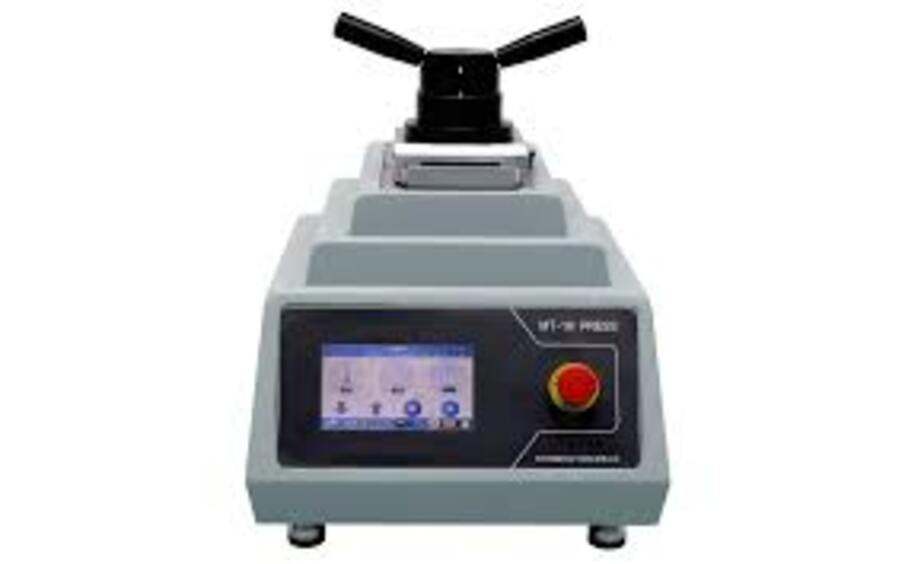
We are offering a high-quality Hot Mounting Press used for mounting metallurgical and material samples using heat and pressure. This equipment is widely used in metallurgical laboratories, research centers, and educational institutes for preparing specimens for microscopic examination and material testing.
The machine ensures strong, uniform, and high-quality mounting of samples in thermosetting resins. It provides controlled heating and pressure to produce crack-free and durable mounts. The equipment is easy to operate, highly reliable, and designed for long-term laboratory use.
Product Details
- Usage: Sample Mounting / Metallurgical Preparation
- Application: Metallurgical Laboratory / Material Testing Lab
- Material: Mild Steel / Stainless Steel
- Feature: Heat & Pressure Controlled, Durable, Accurate Mounting
- Operation: Electric / Semi-Automatic
- Condition: New
Advanced Mounting TechnologyThis hot mounting press leverages digital controls for precision in sample preparation. With a rapid heating element and robust build, it ensures accurate and repeatable mounting cycles. The machine is ideal for metallographic applications where consistency and integrity of samples are critical for microscopic evaluation.
User-Friendly OperationFeaturing both manual and automatic sample ejection, a simple control interface, and an audio-visual cycle completion indicator, the press is easy to operate even for users new to metallographic processes. Safety is prioritized through an emergency stop button and overcurrent protection.
Versatile and Durable DesignThe device is crafted from heavy-duty, powder-coated mild steel, ensuring longevity and reliability. Mould diameters of 25 mm and optional 30 mm enable work on various sample sizes, making it suitable for diverse applications in research institutes, quality control labs, and manufacturing facilities.
FAQ's of Hot Mounting Press:
Q: How does the automatic hot mounting press improve metallographic sample preparation?
A: The hot mounting press automates the mounting process with digital controls, enabling precise temperature, pressure, and timing adjustments. Its rapid heating and water-cooled system reduce preparation time, while audio-visual indicators and automatic ejection ensure sample integrity and efficient workflow.
Q: What materials can be used with this mounting press?
A: This press is compatible with both thermosetting and thermoplastic powders, allowing flexibility in sample mounting for different analytical requirements. Its temperature resistance up to 200C ensures reliable results with various mounting materials.
Q: When should the mould diameter be changed from 25 mm to 30 mm?
A: Changing the mould diameter depends on your sample size and analysis requirements. Use the 25 mm diameter for standard applications, and opt for the 30 mm mould when larger samples need to be encased for metallographic examination.
Q: Where can this equipment be installed and used effectively?
A: Due to its compact design (370 mm x 270 mm x 430 mm) and robust construction, this hot mounting press is well-suited for installation in laboratories, quality control departments, and academic research facilities throughout India.
Q: What safety features are included with this hot mounting press?
A: The press is equipped with an emergency stop button and overcurrent protection, ensuring user safety and equipment security during operation. Overheat protection further enhances safe, continuous use in busy lab environments.
Q: How does the cooling system benefit the mounting process?
A: The water-cooled system rapidly cools the mounted samples after the heating cycle, preserving material structure and minimizing wait times between batches, which increases laboratory efficiency.
Q: What are the main benefits of using a digital timer and temperature controller in this press?
A: Digital controls offer accurate settings for both timer and temperature, ensuring reproducibility of results. The clear LED digital display allows users to monitor and adjust parameters in real-time, improving sample quality and reducing the likelihood of operational errors.

 Send Inquiry




 Send Inquiry


 Send Inquiry