Marshall Stability Test Apparatus About
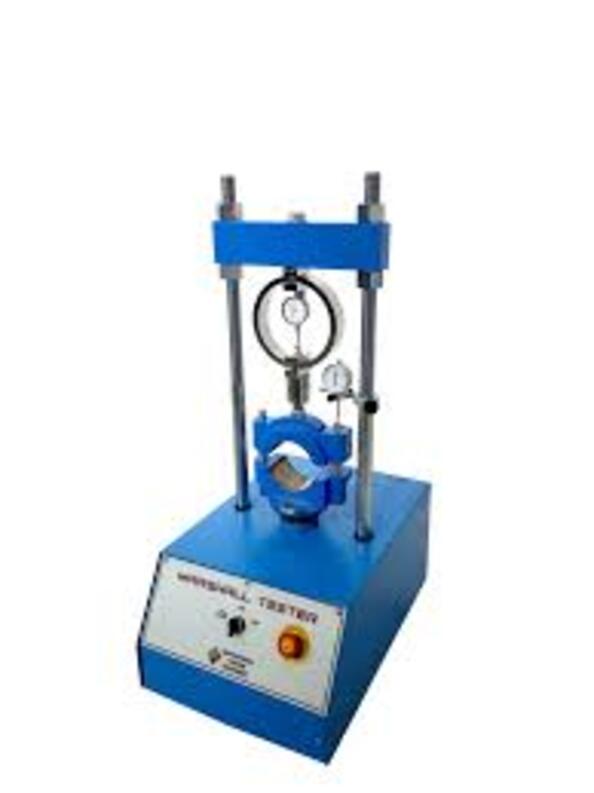
A Marshall Stability Test Apparatus is a standard laboratory equipment used to determine the stability and flow characteristics of bituminous (asphalt) mixes. It plays a crucial role in road construction, pavement design, and quality control testing by evaluating the resistance of bitumen mix to plastic deformation under load.
Key Features:
- Designed as per ASTM D1559, ASTM D6927, AASHTO T245 standards
- Motorized loading unit with capacity up to 5000 kgf / 50 kN
- Fixed loading speed of 50.8 mm/min (5.08 cm/min)
- Equipped with proving ring / load cell and flow measurement dial gauge
- Sturdy two-column frame with adjustable crosshead
- Available in analog and digital models
- Durable construction suitable for laboratory and field testing
Working Principle:
The apparatus measures the maximum load (stability) a compacted bituminous specimen can withstand at a standard temperature of 60C. Simultaneously, it measures flow value, which indicates deformation under load.
The test helps determine the optimum bitumen content for a mix based on traffic and load conditions.
Applications:
- Highway and road construction projects
- Asphalt and bitumen testing laboratories
- Quality control in civil engineering works
- Research institutes and educational labs
- Government and infrastructure agencies
Standard Accessories:
- Marshall moulds (101.6 mm dia 76 mm height)
- Compaction rammer (4.5 kg with 457 mm fall)
- Breaking head assembly with flow meter provision
- Proving ring / load cell
- Dial gauge (0.01 mm least count)
- Compaction pedestal and extraction tools
- Water bath (optional)
Technical Specifications (Typical):
- Capacity: 050 kN
- Test speed: 50.8 mm/min
- Specimen size: Up to 25 mm aggregate size
- Power supply: 220240V, 50Hz, Single Phase
- Measurement: Stability (kN) & Flow (mm)
Advantages:
- Accurate evaluation of asphalt mix strength and durability
- Helps optimize binder content for pavement design
- Widely accepted and standardized testing method
- Reliable and repeatable results
Precision in Bituminous Mix TestingThe Marshall Stability Test Apparatus is crafted for laboratories and field applications to determine the stability and flow values of bituminous mixtures. Its 0.01 kN accuracy ensures precise and reliable readings. The device is especially useful for verifying pavement quality and optimizing mix designs according to international standards.
Advanced Features and VersatilityThis apparatus combines mechanical robustness and digital convenience. Choose between analog or digital dial gauges and manual or automatic operation modes to fit your testing workflow. Its sturdy mild steel and aluminum construction, along with included essential accessories, allow for rigorous and repeatable tests under a variety of operating conditions.
FAQ's of Marshall Stability Test Apparatus:
Q: How does the Marshall Stability Test Apparatus work in measuring bituminous mixtures?
A: The apparatus applies a controlled load to a cylindrical bituminous specimen using a crosshead moving at 50.8 mm/min. The load at which the specimen fails (Marshall stability) and the deformation (flow value) are then precisely measured using a proving ring and dial gauge.
Q: What specimens can be tested using this equipment?
A: This unit is specifically designed for cylindrical bituminous specimens with dimensions of 101.6 mm in diameter and 63.5 mm in height, as per standard Marshall mix design procedures.
Q: When should the optional water bath be used during testing?
A: The optional water bath, which can heat up to 60C, is used when simulating conditions that bituminous materials might face in warm climates. It helps condition specimens prior to testing for more accurate results.
Q: Where is the Marshall Stability Test Apparatus typically used?
A: It is commonly employed in road construction laboratories, research institutions, and quality control departments to analyze bituminous mix performance and ensure pavement reliability.
Q: What is the process for conducting a test with this apparatus?
A: Prepare the specimen, heat if required, place it in the breaking head assembly, and initiate loading. The apparatus records the maximum load with the proving ring and correlates the deformation through the dial gauge, following standard operating procedures.
Q: How does the apparatus benefit pavement engineers and contractors?
A: It provides critical data on the stability and flow of paving mixtures, enabling engineers to optimize blend designs and ensure compliance with construction specifications, ultimately leading to more durable roadways.
Q: What are the advantages of having both manual and automatic control options?
A: Manual and automatic controls provide flexibility, allowing users to select the best operation method for their testing requirements, improving ease of use and repeatability across various test conditions.

 Send Inquiry




 Send Inquiry


 Send Inquiry