Single Stage Vacuum Pump About
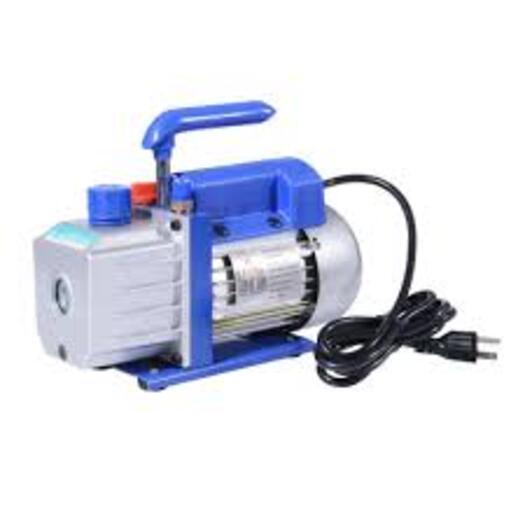
A Single Stage Vacuum Pump is a highly efficient device used to create vacuum pressure by removing air and gases from a sealed system using a single-stage compression mechanism. It is widely used in laboratories, refrigeration servicing, filtration, and industrial processes for reliable and consistent vacuum generation.
Key Features:
- Single-stage rotary vane mechanism for simple and efficient vacuum creation
- High pumping speed for rapid evacuation of air and gases
- Compact and portable design for easy handling and installation
- Low maintenance and durable construction
- Oil-sealed system ensures smooth operation and longer service life
- Equipped with visible oil window to monitor oil level
- Air-cooled motor for continuous operation
Working Principle:
The pump works on a rotary vane mechanism, where a rotor with sliding vanes rotates inside a chamber. This motion traps and compresses air in a single stage, then expels it, creating a vacuum inside the system.
Applications:
- Laboratory filtration and distillation
- Vacuum drying and degassing
- Refrigeration and air conditioning servicing
- Vacuum packaging and forming
- Chemical and pharmaceutical industries
- Leak detection systems
Technical Specifications (Typical):
- Pumping Speed: 1.8 8 CFM (approx.)
- Ultimate Vacuum: Up to 25 Pa
- Motor Power: 1/4 HP to 1 HP
- Oil Capacity: 250500 ml
- Power Supply: 220240V, 50Hz
- Construction: Aluminum alloy / corrosion-resistant body
Advantages:
- Simple design with single-stage compression
- Cost-effective compared to dual-stage pumps
- Easy maintenance and operation
- Suitable for medium vacuum requirements
High Performance and FunctionalityThis vacuum pump offers a compact, rectangular form factor, combining a displacement rate of 3 CFM and a vacuum level of 5 Pa. Engineered from premium aluminium alloy and cast iron, it ensures reliable, extended use in demanding environments, while the air-cooled system keeps operations safe.
Versatile ApplicationsSuitable for diverse uses, such as refrigeration repair, air conditioning maintenance, laboratory experiments, and vacuum packing, this pump delivers consistent results across multiple domains. Its manual control and lightweight built make it extremely user-friendly for field or laboratory work.
Energy-Efficient OperationPowered by a 1/4 HP motor at 220V/50Hz, this vacuum pump achieves optimal vacuum with minimal power consumption. Its oil-sealed mechanism ensures high-efficiency operation, and its robust components withstand temperatures from -30C to +120C, ensuring durability.
FAQ's of Single Stage Vacuum Pump:
Q: How do I use the Single Stage Vacuum Pump for refrigeration or laboratory applications?
A: To use the pump, connect the 1/4" SAE inlet port to your system, ensuring it is securely fastened. Power on the pump using a 220V/50Hz single-phase outlet, check the oil level (250 ml capacity), and monitor the analog gauge to reach the desired vacuum pressure. Refer to the manual for specific connections relevant to refrigeration or laboratory tasks.
Q: What maintenance is required for this vacuum pump?
A: Routine maintenance involves checking and replacing oil regularly, verifying the inlet port is clear of obstructions, inspecting for leaks, and ensuring the air cooling system is unobstructed to maintain efficient operation and prolong pump life.
Q: When should I replace the pump oil?
A: Oil should be checked after each use and replaced when it appears cloudy or contaminated. Regular oil changes maintain the pump's sealing efficiency and protect internal components from wear.
Q: Where can this vacuum pump be used?
A: This vacuum pump is suitable for use in workshops, laboratories, refrigeration and air conditioning services, as well as in food or industrial vacuum packing environments, due to its portability and durable construction.
Q: What are the benefits of the air-cooled and oil-sealed design?
A: The air-cooled system prevents overheating during extended use, while the oil-sealed design enhances vacuum efficiency and protects internal moving parts, ensuring consistent performance and longer service intervals.
Q: How does the analog gauge benefit operation?
A: The analog gauge provides real-time, accurate readings of the vacuum level, allowing users to precisely control the evacuation process and ensure their application achieves optimal vacuum conditions.

 Send Inquiry



 Send Inquiry


 Send Inquiry