Turbidity Meter About
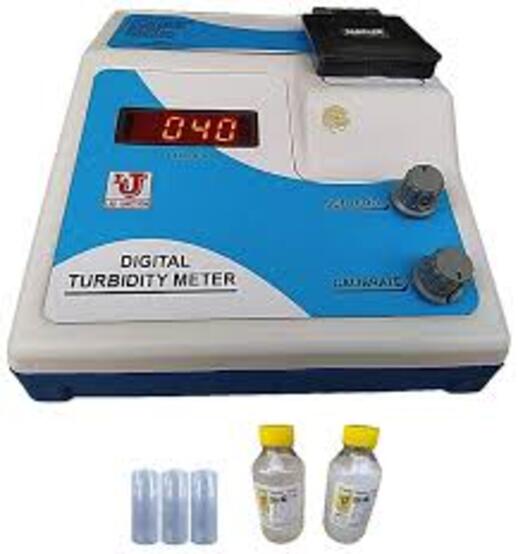
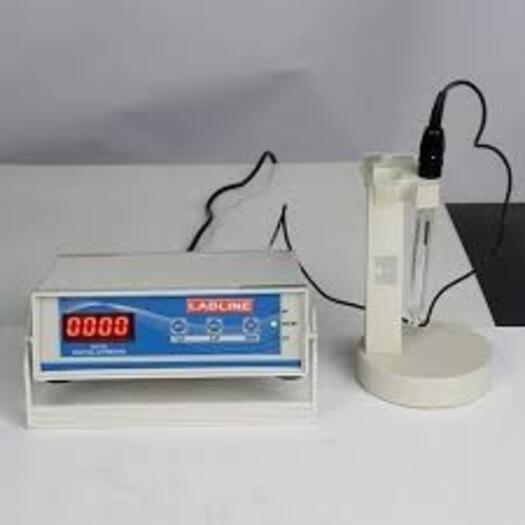
The Turbidity Meter is a precision analytical instrument used to measure the clarity or cloudiness of liquids by detecting the amount of suspended particles present in a sample. It provides readings in NTU (Nephelometric Turbidity Units), making it essential for water quality monitoring and treatment processes.
This instrument is widely used in drinking water plants, wastewater treatment facilities, environmental monitoring agencies, and industrial laboratories.
Key Features:
- Digital Display: Easy-to-read LCD/LED screen showing NTU values
- High Accuracy Measurement: Provides reliable turbidity readings for quality control
- Microprocessor-Based System: Ensures stable and repeatable results
- Fast Response Time: Quick measurement with minimal sample preparation
- Compact & Portable Design: Suitable for both lab and field use
- Easy Calibration: Simple calibration using standard solutions
Working Principle:
The Turbidity Meter works on the nephelometric principle, where a light beam passes through the liquid sample. Suspended particles scatter the light, and the intensity of scattered light is measured at a specific angle to determine turbidity in NTU.
Applications:
- Drinking water quality testing
- Wastewater and effluent monitoring
- Environmental water analysis (rivers, lakes, reservoirs)
- Food and beverage industries
- Pharmaceutical quality control
- Laboratory research and education
Technical Specifications:
- Measuring Range: 0 1000 NTU (or as per model)
- Resolution: 0.01 / 0.1 NTU
- Accuracy: 2% of reading
- Light Source: LED / Tungsten lamp
- Detector: Photodiode sensor
- Display: Digital LCD/LED
- Power Supply: 220V AC / Battery operated (optional)
Advantages:
- Accurate and quick turbidity measurement
- Easy operation with minimal training
- Portable for field and lab applications
- Low maintenance and long service life
Optional Features:
- Data storage and export (USB/RS232)
- Auto-ranging capability
- Battery backup for field use
- Multi-point calibration system
Limitations:
- Requires regular calibration for best accuracy
- Sample cells must be clean and scratch-free for correct readings
Reliable Water Quality AssessmentEngineered for versatility, this Turbidity Meter meets the stringent requirements of laboratory, industrial, and field use. It supports sample volumes from 10 to 30 ml and can operate seamlessly between 0-50C. Digital controls and a user-friendly interface streamline daily operations, making routine testing both quick and dependable. Its portable tabletop build ensures ease of transport and setup in different settings.
Advanced Calibration and AccuracyThe device features a robust calibration process with standard solutions at 0, 20, 100, 400, and 800 NTU, optimizing measurement accuracy up to 2% FS. Automated zeroing and digital display guarantee consistent, high-precision readings for every test. These advantages make it ideal for professional applications where compliance and data integrity are crucial.
Broad Application SpectrumThis turbidity meter is widely suitable for water treatment plants, laboratories, environmental monitoring agencies, and industrial quality control. Whether for routine monitoring or detailed analysis, its blend of reliability and simplicity ensures optimal performance across various testing scenarios. The instrument also offers RS232 connectivity on select models for efficient data management.
FAQ's of Turbidity Meter:
Q: How is the Turbidity Meter calibrated for optimal accuracy?
A: The meter uses predefined calibration standards at 0, 20, 100, 400, and 800 NTU. Calibration is an automatic process; simply follow the digital display prompts to use the provided standard solutions, ensuring readings remain within the 2% FS accuracy range.
Q: What applications is this Turbidity Meter suitable for?
A: This instrument is designed for water quality analysis across laboratory, industrial, and environmental monitoring purposes. It is especially useful in water treatment plants, research labs, and field studies requiring consistent turbidity measurements.
Q: Where can the Turbidity Meter be used considering its operating environment?
A: The meter operates effectively within 0-50C and up to 85% relative humidity, making it appropriate for controlled indoor environments such as laboratories or onsite water testing in industrial settings. The robust design also allows storage between -20C and 60C.
Q: What benefits does the automatic zeroing and digital display offer?
A: The automatic zeroing feature ensures baseline accuracy before each measurement, while the digital LED display provides clear, real-time readouts. This combination guarantees reliable, stable readings with minimal user intervention.
Q: How should samples be prepared and processed for measurement?
A: Prepare a sample volume between 10 and 30 ml, ensuring it's homogenous and free from bubbles or debris. Place the sample in the designated vial, insert it into the meter, and initiate the measurement using the digital controls. Results are typically available within five seconds.
Q: What are the advantages of the infrared LED and tungsten lamp light sources?
A: Both light sources ensure precise detection of suspended particles, improving measurement reliability. Infrared LEDs reduce background interference for colored samples, while tungsten lamps are ideal for broader water sample types, enhancing instrument versatility.

 Send Inquiry



 Send Inquiry


 Send Inquiry