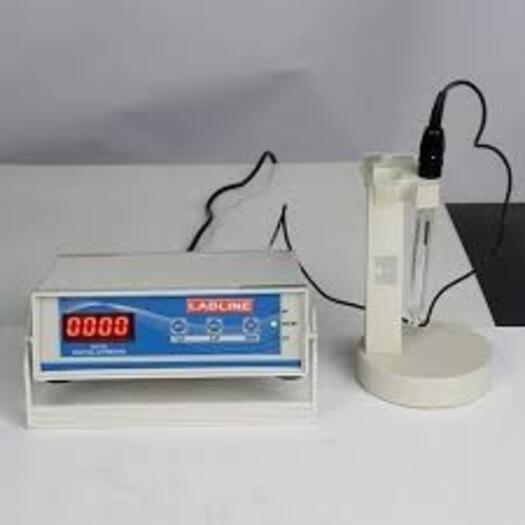
Digital Conductivity Meter About
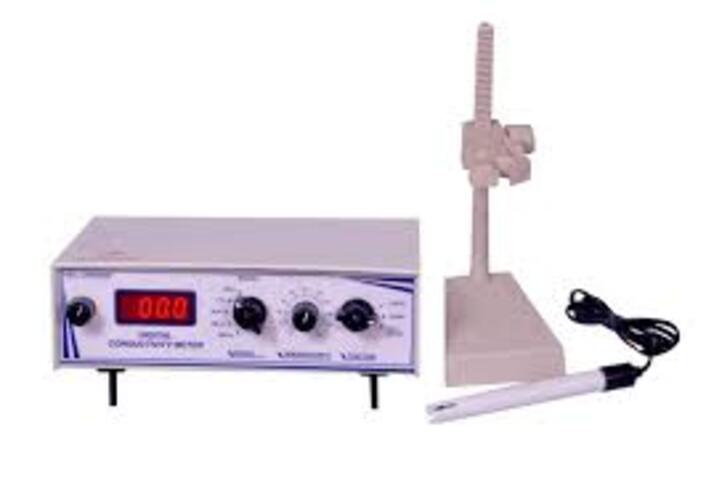
The Digital Conductivity Meter is a precision laboratory instrument used for measuring the electrical conductivity (EC) of water and aqueous solutions. It helps determine the ionic concentration in a sample, making it an essential tool for water quality analysis and process control applications.
This instrument is widely used in water treatment plants, environmental laboratories, chemical industries, pharmaceutical units, RO plants, agriculture testing labs, and research institutions.
Key Features:
- Digital LCD Display: Clear and accurate conductivity readings
- High Precision Measurement: Ensures reliable and repeatable results
- Microprocessor-Based Design: Stable and consistent performance
- Automatic / Manual Calibration: Multi-point calibration for better accuracy
- Temperature Compensation (ATC): Automatically adjusts readings with temperature changes
- User-Friendly Interface: Simple operation with fast response
- Compact and Durable Build: Suitable for laboratory environments
Working Principle:
The instrument measures the ability of a solution to conduct electricity using a conductivity probe (cell). The ionic concentration in the liquid affects conductivity, which is measured and displayed in S/cm or mS/cm.
Applications:
- Drinking water quality testing
- Wastewater and effluent monitoring
- RO plant performance evaluation
- Chemical and pharmaceutical industries
- Soil and fertilizer analysis
- Hydroponics and agricultural research
- Laboratory R&D and educational use
Technical Specifications:
- Measuring Range: 0 200 mS/cm (varies by model)
- Resolution: 0.1 S/cm / 1 S/cm
- Accuracy: 1% of full scale (approx.)
- Calibration: 13 point calibration
- Temperature Compensation: Automatic (ATC) / Manual
- Display: Digital LCD
- Power Supply: 220V AC / Adapter
Advantages:
- Accurate measurement of ionic strength in liquids
- Quick and stable readings
- Easy calibration and maintenance
- Suitable for both routine and advanced laboratory use
Optional Features:
- TDS measurement mode
- Salinity measurement function
- Data output (USB/RS232)
- Combined pH/EC/TDS multi-parameter systems
Limitations:
- Requires periodic calibration for best accuracy
- Conductivity probe needs regular cleaning and maintenance
Precision Measurement for Reliable ResultsEquipped with a high-grade platinum electrode conductivity cell and selectable measurement ranges, this meter delivers accuracy of 1% F.S., making it suitable for demanding applications. Manual temperature compensation and two-point calibration allow for customized, reliable measurements across various liquid samples.
Robust and User-Friendly DesignEncased in a powder-coated metal cabinet, the meter stands up to routine laboratory and industrial operations. The clear digital LED display, manual controls, and bench-top frame provide ease of use and durability, while a protective internal fuse (0.5A) ensures operational safety.
Comprehensive Accessories and Flexible ApplicationSupplied with a conductivity cell, instruction manual, and power cord, this meter is ready for immediate deployment. Its multi-range functionality and temperature compensation cater to a wide range of liquid conductivity measurements, making it a valuable asset in numerous laboratory and field scenarios.
FAQ's of Digital Conductivity Meter:
Q: How do I calibrate the Digital Conductivity Meter?
A: Calibration is performed manually using a two-point process-Zero and Span. Use standard conductivity solutions to set both points, following the instructions provided in the manual. This ensures the meter maintains optimal measurement accuracy.
Q: What types of liquids can I measure with this meter?
A: This instrument is suitable for measuring the conductivity of a wide variety of liquids, including water, solutions in laboratory experiments, and industrial process fluids. Its selectable ranges and robust design enable diverse applications.
Q: When should temperature compensation be used, and how is it adjusted?
A: Temperature compensation should be used when measuring samples at temperatures between 10C and 50C to account for changes in conductivity with temperature. Adjust it manually by inputting your sample's temperature using the meter's controls.
Q: Where can this conductivity meter be effectively utilized?
A: The meter is suited for laboratory research, educational demonstrations, and quality control in industrial facilities. Its portability and rugged build make it ideal for bench-top use in various environments across the laboratory, industry, and educational institutions.
Q: What is the process for connecting the probes and starting a measurement?
A: First, attach the supplied conductivity cell and temperature probe to their respective inputs on the meter. Select the appropriate range, immerse the probe in your sample, manually set the temperature compensation if needed, and read the value on the digital LED display.
Q: What are the main benefits of using this conductivity meter?
A: Key benefits include high accuracy, configurable measurement ranges for flexibility, manual temperature compensation for reliable results, and a robust, portable design that withstands demanding environments. Its clear digital display and simple controls enhance user experience.

 Send Inquiry



 Send Inquiry


 Send Inquiry