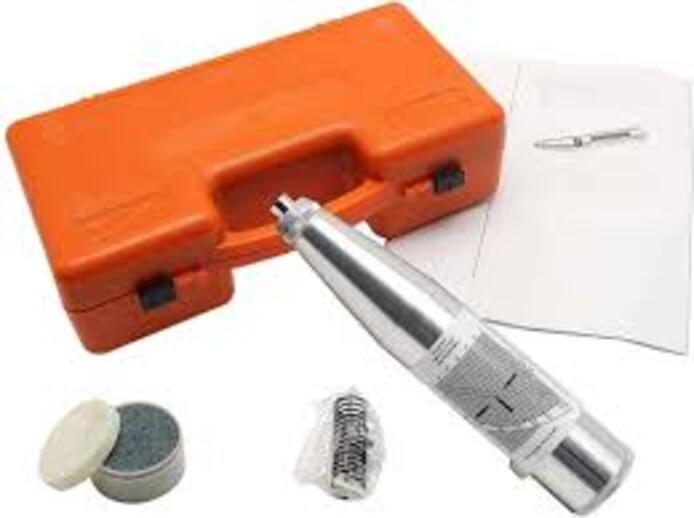
Concrete Test Hammer About
l for engineers, contractors, and quality inspectors to quickly evaluate the condition and uniformity of concrete structures without causing any damage.
Key Features
- Simple and Reliable Operation
- Mechanical or Digital Display Options
- High Durability with Metal Body Construction
- Accurate Rebound Measurement System
- Lightweight and Portable Design
- No External Power Required (Mechanical Type)
- Suitable for On-Site Testing
Technical Specifications
- Measuring Range: 10 70 MPa (approx.)
- Impact Energy: 2.207 Joules (Standard Type N)
- Accuracy: 12 Rebound Numbers
- Material: Hardened Steel / Aluminum Body
- Weight: Approx. 11.5 kg
- Standards Compliance: IS 13311 (Part 2), ASTM C805
Applications
- Estimating compressive strength of concrete
- Checking uniformity of concrete structures
- Assessing quality of construction work
- Detecting weak or deteriorated areas
- Used in buildings, bridges, dams, and precast structures
Advantages
- Non-destructive testing method
- Quick and easy results on-site
- Cost-effective solution for quality control
- No damage to tested structure
Typical TradeIndia Listing Details
- Product Type: Concrete Test Hammer / Rebound Hammer
- Usage: Construction & Civil Engineering Testing
- Color: Orange / Yellow / Customized
- Warranty: 6 Months 1 Year
- Price Range: 5,000 25,000 (Mechanical Type)
Engineered for Precision and DurabilityConstructed from high-strength steel and featuring a durable alloy hammer tip, this device ensures long-lasting, consistent performance. The analog scale enables immediate and precise reading, while factory calibration guarantees reliability. Its robust build makes it dependable for frequent site applications in various environmental conditions, supporting humidity up to 90% RH and temperatures from 0C to 40C.
Effortless Non-Destructive Testing on SiteDesigned for manual, handheld operation, the Concrete Test Hammer offers portability during concrete structure evaluations. No external power or batteries are needed due to its mechanical spring-operated mechanism, ensuring readiness for testing anywhere. Its compact size and straightforward analog readout streamline testing, allowing quick, repeatable assessments by a single operator.
FAQ's of Concrete Test Hammer:
Q: How is the Concrete Test Hammer used to assess concrete strength?
A: The hammer is placed against the concrete surface and activated manually, delivering a controlled impact. The rebound value, displayed on the analog scale, corresponds to the surface hardness, which is then related to compressive strength per standard charts.
Q: What is the benefit of using a mechanical spring-operated test hammer?
A: Its mechanical design eliminates the need for batteries or external power, allowing immediate use on any site. This ensures portability, uninterrupted operation, and low maintenance requirements.
Q: When should I use this hammer during construction projects?
A: Use the hammer for quality assurance at various stages-such as after curing, before further structural additions, or during inspection-to quickly verify surface strength and uniformity without damaging the concrete.
Q: Where can the Concrete Test Hammer be applied?
A: It is ideal for on-site testing of concrete walls, columns, beams, and other structures where direct compressive strength information is required without extracting samples.
Q: What is the process for obtaining a calibrated measurement?
A: Each hammer is supplied factory-calibrated with a certificate. Regular use, as outlined in the user manual, ensures accuracy-readings are taken directly from the analog scale after each impact. Routine re-calibration is recommended based on usage intensity.
Q: How does the analog scale on the test hammer enhance usability?
A: The direct analog scale offers instant reading of rebound values, facilitating quick assessment for field engineers, reducing downtime, and allowing efficient one-handed operation.
Q: What is the minimum specimen thickness required for reliable testing with this device?
A: To achieve accurate readings, the concrete specimen should have a minimum thickness of 100 mm, ensuring the impact energy is properly absorbed and results are representative of actual surface hardness.

 Send Inquiry



 Send Inquiry


 Send Inquiry