Glass Density Bottles About
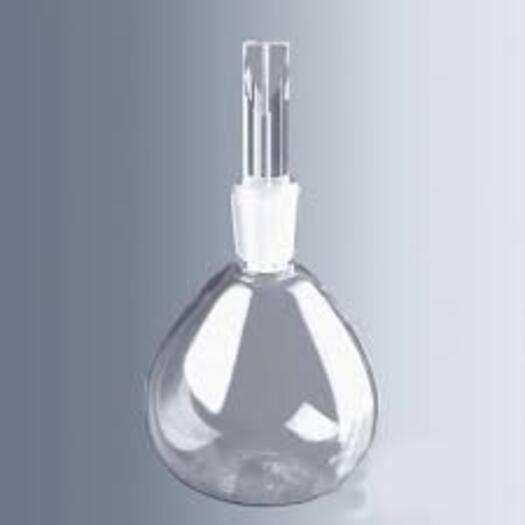
Glass Density Bottles are precision laboratory glassware used for determining the density or specific gravity of liquids, chemicals, and suspensions. They are widely used in research laboratories, quality control departments, and educational institutions for accurate measurement of liquid density under controlled conditions.
These bottles are manufactured from high-quality borosilicate glass, ensuring excellent chemical resistance, thermal stability, and long service life. Each bottle is designed with a tight-fitting stopper to prevent leakage and ensure precise volume measurement during testing.
Glass Density Bottles are available in various capacities and are calibrated for high accuracy, making them suitable for routine analytical and laboratory applications.
Key Features:
- Made from high-quality borosilicate glass
- High accuracy for density and specific gravity measurement
- Chemically resistant and heat resistant
- Leak-proof stopper for precise results
- Available in multiple capacities
- Easy to clean and reusable
Applications:
- Chemical and pharmaceutical laboratories
- Soil and material testing laboratories
- Research and development labs
- Educational institutions
- Quality control departments in industries
Working Principle:
The bottle is filled with a known volume of liquid, and its mass is measured. The density is calculated by dividing the mass of the liquid by its fixed volume, ensuring accurate and reliable results.
Precision-Crafted Laboratory GlasswareBuilt from durable borosilicate glass, our density bottles are tailored for longevity and chemical resistance, ensuring reliable performance for diverse analytical tasks. The narrow neck and ground glass stopper provide secure closure, reducing evaporation and contamination risks during measurements.
Compliance and Measurement AccuracyComplying with ISO 385:2005 and ASTM E287 standards, these bottles are rigorously calibrated for dependability. The clear calibration mark at the neck allows for accurate and consistent filling, enabling precise volume assessment essential for reproducible density calculations in laboratory settings.
Safe Packaging and Versatile CapacitiesEach glass density bottle is individually packaged, prioritizing safe transport and storage. With capacities available from 25 ml to 500 ml, users can select the appropriate size for their experimental requirements, ensuring both convenience and precision during laboratory procedures.
FAQ's of Glass Density Bottles:
Q: How are glass density bottles used for measuring liquid density?
A: To measure liquid density, fill the stoppered glass density bottle up to the calibration mark with the test liquid, weigh it, then empty and dry the bottle, and weigh it again. The difference in weight gives you the mass of the liquid, which, when divided by the known volume (as indicated by the calibration mark), yields the liquid's density.
Q: What advantages does borosilicate glass offer for laboratory density bottles?
A: Borosilicate glass is highly resistant to thermal shock, chemical corrosion, and staining, making it ideal for repeated use in laboratories. Its clarity and durability ensure accurate volume reading and long-lasting performance in density determination applications.
Q: When should I use different bottle capacities like 25 ml, 50 ml, or 500 ml?
A: Choose the bottle capacity based on the volume of liquid you need to measure and the precision required for your experiment. Smaller volumes (like 25 ml) are suitable for scarce or precious samples, while larger bottles (up to 500 ml) are preferred for bulk measurements or when greater sample size improves accuracy.
Q: Where are these glass density bottles typically used?
A: These density bottles are widely used in analytical laboratories, research institutes, educational labs, and industrial settings where precise liquid density measurements are essential for quality control, research, or educational purposes.
Q: What is the process for cleaning and maintaining glass density bottles?
A: After each use, rinse the bottle thoroughly with distilled water to remove residue, then clean with a suitable laboratory detergent. Avoid abrasive cleaners to preserve the clarity and smooth finish. Allow bottles to dry completely before storing to maintain accuracy and prevent contamination.
Q: How does the calibration mark enhance measurement accuracy?
A: The calibration mark at the neck of the bottle indicates the precise volume for measurement. Filling the bottle exactly to this mark ensures each measurement uses the correct volume, reducing error and enhancing the consistency of density calculations.
Q: What unique benefits do these glass density bottles offer compared to alternatives?
A: Their compliance with international standards, precise manual measurement capability, robust borosilicate glass construction, and individually packed design combine to deliver exceptional reliability, accuracy, and user safety in laboratory density determinations.

 Send Inquiry



 Send Inquiry


 Send Inquiry