Niskin Water Sampler About
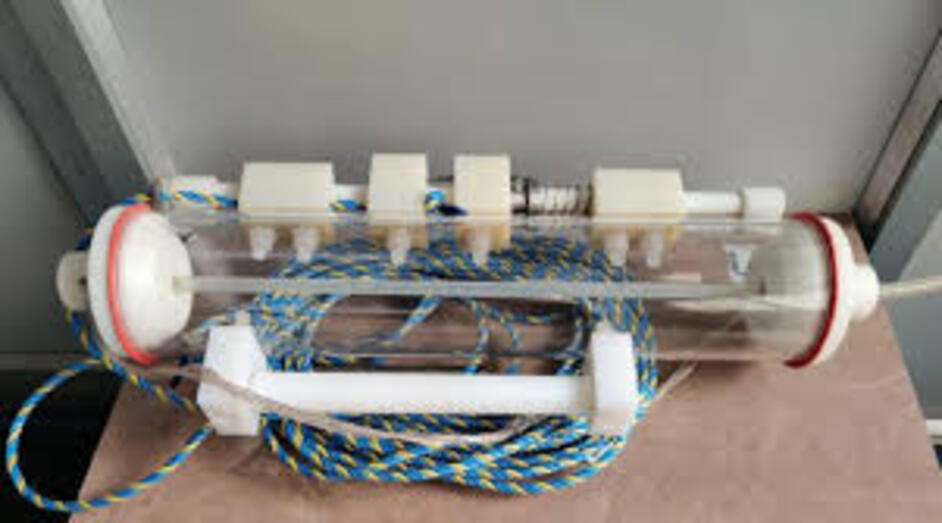
The Niskin bottle is a cylindrical tube, usually made of plastic (PVC) or metal, with open ends that can be sealed at a desired depth. It is designed to capture water at a precise location in the water column for chemical, biological, and physical analysis.
Key Features
- Cylindrical tube: Typically 130 liters in capacity
- End caps (stoppers): Spring-loaded lids that close tightly
- Messengers or electronic triggers: Used to activate closure at depth
- Non-contaminating material: Prevents alteration of water chemistry
- Mounting frame: Often attached to a rosette system for multiple samples
Working Principle
- The sampler is lowered into the water with both ends open, allowing water to flow freely through it.
- At the desired depth, a messenger weight (or electronic signal) is sent down the cable.
- This triggers the end caps to snap shut, trapping water from that exact depth.
- The sampler is then retrieved, and the collected water is transferred for analysis.
Uses
- Oceanography: Studying seawater properties at different depths
- Environmental monitoring: Detecting pollutants or contaminants
- Marine biology: Analyzing plankton and microorganisms
- Chemical analysis: Measuring salinity, nutrients, dissolved oxygen
Types / Variations
- Standard Niskin bottle: General-purpose water sampling
- Rosette system: Multiple Niskin bottles arranged in a circular frame for sampling at different depths in one deployment
- Closing mechanisms: Mechanical (messenger-triggered) or electronic
Robust Construction for All EnvironmentsDesigned for both marine and freshwater sampling, the Niskin Water Sampler utilizes non-corrosive materials like PVC or polycarbonate, combined with stainless steel fittings and corrosion-resistant finish. These features ensure consistent durability and long-lasting performance under various environmental conditions, making it well-suited for both research and routine field use.
Efficient and Reliable Sampling MechanismThe sampler employs a spring-loaded or cable-triggered end cap system, allowing users to collect uncontaminated water samples from specific depths with minimal effort. Its secure O-ring seal prevents leaks while the integrated handle simplifies deployment and retrieval. The marked cable provides depth accuracy, enhancing the reliability of sample collection for laboratories and research teams.
Easy Maintenance and Versatile ApplicationsEngineered for simplicity, the sampler is readily disassembled for thorough cleaning, helping maintain sample integrity across multiple uses. With its transparent body, users can easily monitor sample collection and purity. Available in multiple capacities, it is an excellent choice for environmental monitoring, academic research, and industrial water quality assessments.
FAQ's of Niskin Water Sampler:
Q: How do I operate the Niskin Water Sampler to collect water at specific depths?
A: To use the Niskin Water Sampler, lower it to the desired depth using a marked cable. Once the sampler reaches the set depth, trigger the spring-loaded or cable-triggered end caps to seal and collect the water sample. The sealed O-ring ensures the sample remains uncontaminated until retrieval.
Q: What materials are used in the Niskin Water Sampler, and why are they important?
A: The sampler is constructed from non-corrosive PVC or polycarbonate, with stainless steel fittings. These materials are chosen for their resistance to corrosion in both freshwater and seawater, ensuring reliable use over time and maintaining sample quality.
Q: Where is the Niskin Water Sampler commonly used?
A: This sampler is utilized in laboratories, field sampling stations, and marine research sites throughout India, wherever precise water collection from various depths is required for environmental monitoring or scientific study.
Q: What makes the Niskin Water Sampler easy to clean and maintain?
A: The sampler is designed for easy disassembly, allowing for efficient cleaning of all components after each use. This maintenance ensures the integrity and accuracy of future water samples while prolonging the lifespan of the equipment.
Q: When should I choose different capacity models of the Niskin Water Sampler?
A: Capacity choice depends on your specific sampling needs. The standard 2.5L model suits most applications, but larger or smaller sizes are available if your research or monitoring task requires a different sample volume.
Q: What are the key benefits of using a transparent or light grey sampler body?
A: A transparent or light grey body allows clear visibility of the water sample, so you can easily monitor the filling process and assess sample clarity on-site, reducing the risk of collecting contaminated or incomplete samples.
Q: How deep can the Niskin Water Sampler be deployed, and what factors affect this?
A: Depending on the model, the sampler can be deployed up to 2,500 meters. The depth capability is influenced by the construction, cable strength, and environmental pressure limits, making it suitable for a wide range of aquatic environments.

 Send Inquiry



 Send Inquiry


 Send Inquiry