PVC Pipe Friction Apparatus

PVC Pipe Friction Apparatus

Price 60000.0 INR/ Unit

MOQ : 1 Unit

PVC Pipe Friction Apparatus Specification

  • Temperature
  • Ambient (ideally 20-30C)
  • Humidity
  • Ambient
  • Test Range
  • Suitable for measuring friction losses in 1/2 inch PVC pipes
  • Frequency
  • 50 Hz
  • Application
  • Educational demonstration and laboratory experiments
  • Interface Type
  • Manual controls; no digital interface
  • Resolution
  • 0.5 mm water column
  • Port Size
  • Inlet and outlet: 1/2 inch BSP
  • Equipment Type
  • PVC Pipe Friction Apparatus
  • Features
  • Rugged construction, transparent pipeline, easy-to-read scale, bench mounted
  • Display Type
  • Manometric scale
  • Response Time
  • Instantaneous (manometer reading)
  • Max Height
  • Approx. 1 meter
  • Specimen Size
  • 1/2 inch nominal bore PVC pipe
  • Number of Specimens
  • 1 (experiment per pipe at a time)
  • Measuring Range
  • 0-500 mm water head (differential manometer)
  • Operating Voltage
  • 230 V AC
  • Accuracy
  • 1% of reading
  • Power Supply
  • 230 V AC, 50 Hz, Single Phase
  • Automation Grade
  • Manual
  • Mounting Type
  • Bench mounted
  • Usage
  • Friction loss measurement, fluid mechanics experiments
  • Capacity
  • Up to 1.5 bar pressure
  • Machine Weight
  • Approx. 25 kg
  • Test Stroke
  • Approx. 1 meter (length of test pipe)
  • Control Mode
  • Manual
  • Flow Control
  • Needle valve arrangement for flow rate adjustment
  • Finish
  • Powder-coated metal frame
  • Safety Features
  • Non-corrosive parts, leak-proof joints, over-pressure release valve
  • Pipe Length
  • Approx. 1000 mm
  • Manometer Type
  • U-tube differential manometer supplied with connecting rubber tubing
  • Water Reservoir
  • Integrated, with approximately 5 litres capacity
  • Accessories Supplied
  • Flexible hoses, connecting tubes, instruction manual, mounting stand
  • Pipe Material
  • Rigid PVC
  • Discharge Measurement
  • Graduated measuring tank (provided separately)


About PVC Pipe Friction Apparatus

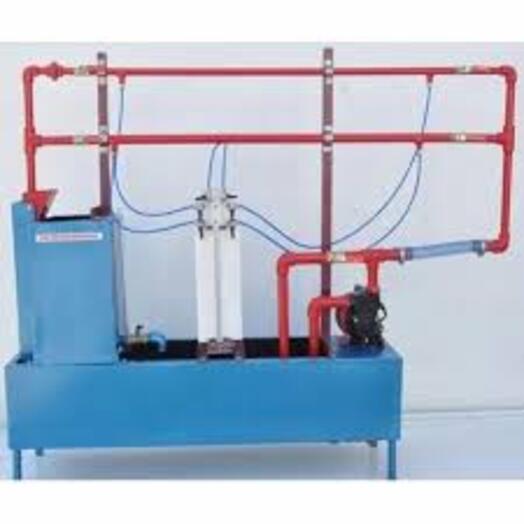
A PVC Pipe Friction Apparatus is a laboratory equipment used to study frictional losses in fluid flow through PVC pipes under different flow conditions. It is widely used in fluid mechanics and hydraulic engineering laboratories in engineering colleges, technical institutes, and research centers for demonstrating the principles of pipe flow and head loss due to friction.

The apparatus consists of a PVC test pipe section, water circulation system, measuring tank, pressure measuring devices, control valves, and supporting framework. It helps students and researchers analyze flow characteristics, determine friction factors, and verify hydraulic equations related to laminar and turbulent flow conditions.

Manufactured using high-quality PVC pipes, corrosion-resistant fittings, and durable metal framework, the apparatus ensures reliable operation, accurate readings, and long service life.

Key Features:

  • High-quality PVC pipe construction
  • Accurate pressure and flow measurement system
  • Corrosion-resistant and durable structure
  • Smooth water circulation arrangement
  • User-friendly operation and maintenance
  • Compact and sturdy design
  • Suitable for laboratory demonstrations and experiments

Applications:

  • Fluid mechanics laboratories
  • Hydraulic engineering experiments
  • Engineering and technical institutes
  • Educational and research purposes
  • Pipe friction and head loss analysis


Practical Fluid Mechanics Learning Tool

Ideal for academic settings, this PVC Pipe Friction Apparatus allows students and researchers to investigate frictional head loss in 1/2 inch PVC pipes. The manual controls promote hands-on learning, and the transparent pipe offers clear observation of flow. Best suited for laboratory demonstrations and practical coursework, the equipment reinforces theoretical concepts in a tangible, interactive way.


Built for Reliability and Safety

Constructed from rigid PVC and a powder-coated metal frame, this apparatus ensures long-lasting performance in classroom and laboratory environments. Its non-corrosive, leak-proof design includes a built-in over-pressure release valve, safeguarding users during operation. The integrated reservoir and accessories further simplify setup and maintenance, while the bench-mounted design ensures stability.

FAQ's of PVC Pipe Friction Apparatus:


Q: How is the PVC Pipe Friction Apparatus used in laboratory experiments?

A: The apparatus is used by connecting the reservoir, filling it with water, and adjusting the flow rate using the needle valve. Students can then measure frictional losses by reading differences on the U-tube manometer while water flows through the 1-meter PVC pipe.

Q: What types of experiments can be performed with this apparatus?

A: Primarily, it is used for measuring frictional losses in rigid PVC pipes, studying the effect of flow rate on head loss, and verifying fluid dynamics theories in a controlled lab setting.

Q: When is it necessary to use the over-pressure release valve?

A: The over-pressure release valve should be used if the internal pressure approaches the apparatus's maximum limit (1.5 bar), ensuring safety and preventing damage to the equipment.

Q: Where should the apparatus be installed for optimal results?

A: Set up the apparatus on a stable laboratory bench in a well-ventilated environment with access to a standard 230 V AC, 50 Hz power supply. Ambient temperature between 20-30C is ideal for accurate readings.

Q: What is the process for measuring friction loss using this equipment?

A: Begin by filling the reservoir and connecting the U-tube manometer. Adjust the flow using the needle valve, observe the water level difference in the manometer, and record the data for analysis of friction loss along the pipe length.

Q: What are the benefits of using a transparent, rigid PVC pipe in this apparatus?

A: The transparent PVC pipe allows users to directly observe fluid flow and behavior, aiding understanding of boundary layers and ensuring easy identification of any operational issues.

Q: How does the manual control mode enhance the learning experience?

A: Manual controls require users to actively adjust flow rates and record readings, fostering deeper engagement and hands-on familiarity with fluid mechanics principles.

Tell us about your requirement
product

Price:

Quantity
Select Unit

  • 50
  • 100
  • 200
  • 250
  • 500
  • 1000+
Additional detail
Mobile number

Email

More Products in Fluid mechanics lab equipment Category

RECIRC-ULATING TYPE JET APPARATUS

RECIRC-ULATING TYPE JET APPARATUS

Price 60000.0 INR / Unit

Minimum Order Quantity : 1 Unit

Usage : Study of the impact of jet and momentum transfer

Measuring Range : Flow rate up to 5 L/min

Specimen Size : Typical 75 mm x 100 mm

Number of Specimens : 1 at a time

RECIRCULATING TYPE PIPE FRICTION

RECIRCULATING TYPE PIPE FRICTION

Price 60000.0 INR / Unit

Minimum Order Quantity : 1 Unit

Usage : Laboratory, Research Institutes, Educational Institutes

Measuring Range : 0250 mm (Manometer)

Specimen Size : Pipe ID: 15 mm

Number of Specimens : 1 at a time

Aniline Point Apparatus

Aniline Point Apparatus

Price 30000.0 INR / Set

Minimum Order Quantity : 1 Set

Usage : Laboratory petroleum product testing

Measuring Range : 30C to 150C

Specimen Size : 23 ml sample

Number of Specimens : One at a time

Redwood Viscometer Apparatus

Redwood Viscometer Apparatus

Price 10000.0 INR / Piece

Minimum Order Quantity : 1 Piece

Usage : Industrial laboratory, Educational demonstration

Measuring Range : Redwood No. 1 (30 to 2000 seconds); Redwood No. 2 (100 to 2000 seconds)

Specimen Size : 50 ml standard sample cup

Number of Specimens : Single specimen per test


Back to top