RECIRCULATING TYPE PIPE FRICTION About
The Recirculating Type Pipe Friction Apparatus is a laboratory equipment designed to study frictional losses in pipes and pipe fittings under different flow conditions. It is widely used in fluid mechanics and hydraulic engineering laboratories of engineering colleges, universities, technical institutes, and research centers for demonstrating the principles of fluid flow through pipes.
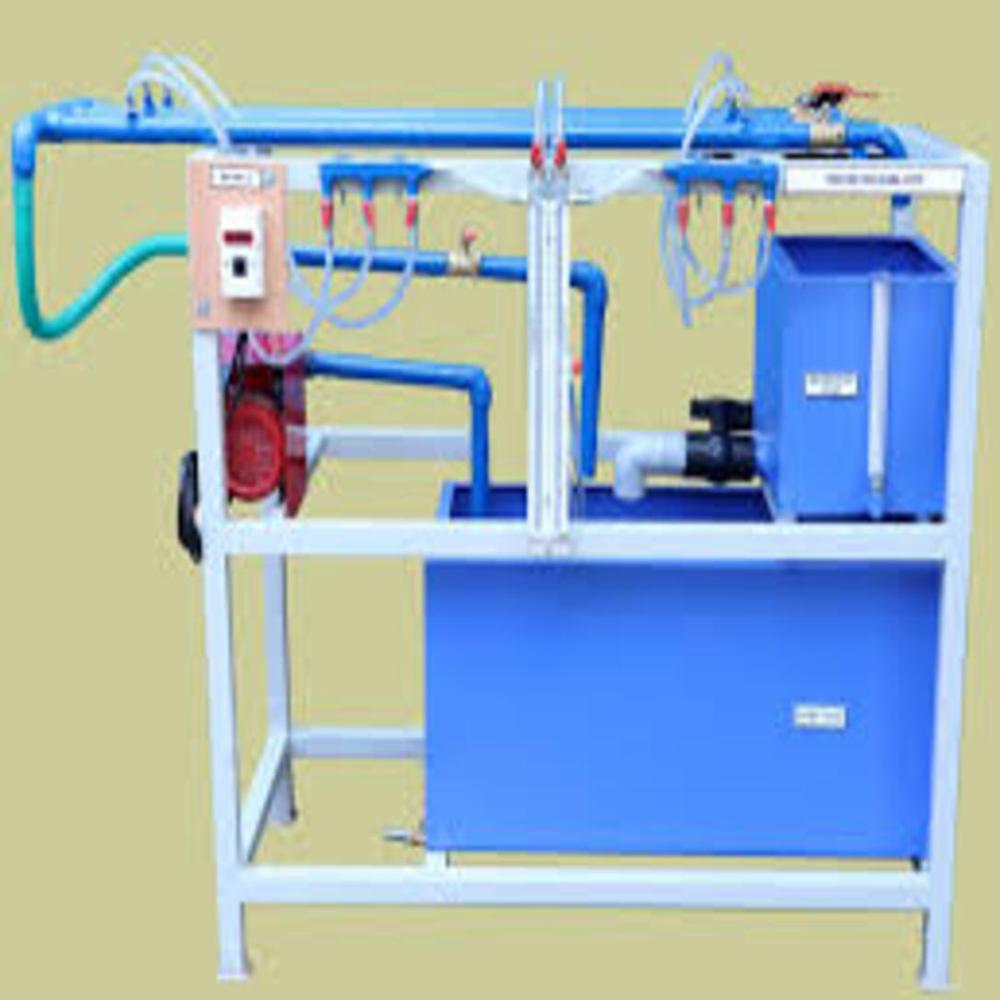
The apparatus consists of a closed-loop recirculating water system equipped with a sump tank, centrifugal pump, test pipe sections of different diameters, pressure measuring devices, flow control valves, and measuring tank. The setup enables accurate determination of head losses due to friction in straight pipes as well as losses through bends, elbows, valves, and fittings.
The recirculating arrangement minimizes water consumption and allows continuous operation for repeated experiments. Differential pressure gauges or manometers are provided for precise measurement of pressure drops across test sections. The apparatus is fabricated using high-quality corrosion-resistant materials to ensure durability, reliability, and long service life.
Its compact and self-contained construction makes it ideal for educational demonstrations, laboratory experiments, and hydraulic research applications.
Features
- Closed-loop recirculating water system
- Accurate measurement of pipe friction losses
- Study of losses through pipe fittings and valves
- Water-saving and continuous operation
- Durable and corrosion-resistant construction
- Easy operation and maintenance
- Compact and self-contained design
- Suitable for laboratory and research use
Applications
- Fluid mechanics laboratories
- Hydraulic engineering studies
- Engineering colleges and universities
- Technical training institutes
- Research and development laboratories
Typical Specifications
- Centrifugal pump with recirculation system
- Test pipe sections of various diameters
- Differential manometer / pressure gauges
- Flow control valves and fittings
- Measuring tank with calibrated scale
- Transparent piping sections for observation
- Sump tank and water reservoir
- Mounted on rigid MS frame structure
Working Principle
The apparatus operates on the principle of fluid flow through pipes where friction between the moving fluid and pipe surface causes head loss. Water is circulated through different pipe sections and fittings, and the pressure drop across the test section is measured using manometers or pressure gauges. The experimental results are used to determine friction factors and analyze flow characteristics under laminar and turbulent conditions.
The apparatus is suitable for experiments on:
- Friction loss in straight pipes
- Determination of Darcy friction factor
- Losses in bends, elbows, and valves
- Laminar and turbulent flow studies
- Verification of hydraulic flow equations
Optimal Design for Accurate Pipe Friction StudiesEngineered to deliver precise fluid dynamics data, this apparatus enables real-time analysis of pipe friction losses utilizing a centrifugal pump-driven recirculating water system. The construction materials ensure durability and reliable performance in educational or research settings. Quick release end connections and castor wheels provide user-friendly assembly and enhanced mobility across labs and institutes.
User-Centric Features and Advanced SafetySafety is prioritized through overflow and electrical cut-off mechanisms, while the analog U-tube manometer ensures instant, accurate readings. Manual and automatic control modes offer versatility for a range of experimental conditions. The apparatus is also straightforward to clean and maintain, thanks to its corrosion-resistant components and HDPE tank.
FAQ's of RECIRCULATING TYPE PIPE FRICTION:
Q: How does the recirculating type pipe friction apparatus measure friction losses in pipes?
A: This equipment assesses friction loss by circulating water through a test loop and reading the pressure differential with a high-precision U-tube manometer. By analyzing water flow at different speeds (up to 200 lph), users can study real-time friction characteristics under controlled conditions.
Q: What are the installation requirements and support provided for this apparatus?
A: The apparatus requires a standard 230 V AC, 50 Hz power supply. On-site installation and demonstration services are available, ensuring you can set up and begin experiments confidently in your laboratory or educational institution.
Q: When should I use manual versus automatic control mode?
A: Manual mode allows direct user control over test parameters, ideal for instructional demonstrations or exploratory research. Automatic mode supports consistent, repeatable testing, particularly useful during extended experiments or precise measurement routines.
Q: Where can this apparatus be utilized most effectively?
A: Designed for laboratory environments in educational institutions and research centers, its compact, table-top and portable nature makes it suitable for classrooms or research labs requiring convenient setup and relocation.
Q: What makes this apparatus user-friendly for repeated use?
A: It features quick release couplings for fast setup and maintenance, corrosion-resistant materials for durability, and a castor wheel-based frame for effortless mobility. The apparatus is easy to operate and clean, suited for frequent educational and testing applications.
Q: How does the equipment ensure operational safety?
A: Integrated safety features include an overflow arrangement to prevent water spillage and an electrical cut-off to safeguard the pump and users, guaranteeing secure operation throughout testing cycles.
Q: What benefits does compliance with IS 3085/ISO 3353 offer?
A: Adherence to these international and national standards ensures that the apparatus provides reliable, accurate, and reproducible results, meeting the rigorous requirements of academic and research applications.

 Send Inquiry



 Send Inquiry


 Send Inquiry