About 4 Stroke Petrol Engine Cut Model
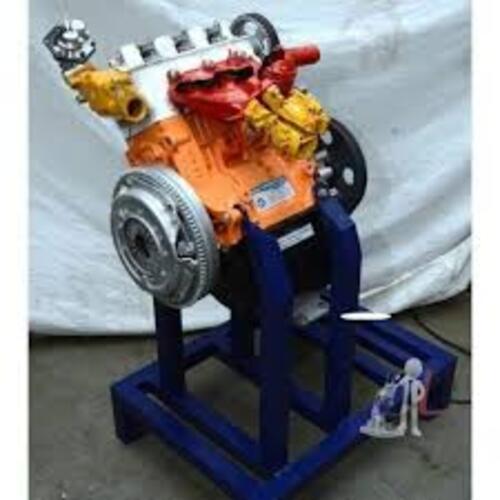
The 4 Stroke Petrol Engine Cut Model is a specially designed educational and demonstration unit used to study the internal construction and working of a four-stroke petrol engine. This model is precisely sectioned to provide a clear view of all important internal components such as the piston, cylinder, crankshaft, inlet and exhaust valves, camshaft, spark plug, and connecting rod.
The model operates on the principle of the four-stroke cycle, which includes suction, compression, power, and exhaust strokes. It may be hand-operated or electrically driven, allowing smooth and slow movement of parts for easy understanding of each stage of the engine cycle.
Constructed with high-quality materials, the cut model is durable, corrosion-resistant, and suitable for long-term use in laboratories and classrooms. It is mounted on a sturdy base frame and painted with different colors to easily identify various parts and mechanisms.
Features
- Clearly visible internal engine components
- Demonstrates complete 4-stroke working cycle
- Strong construction with long service life
- Easy to operate and maintain
- Ideal for practical learning
Applications
Widely used in engineering colleges, polytechnic institutes, ITI workshops, and training centers for teaching students about engine construction, operation, and maintenance.
Comprehensive Visualization of Engine MechanicsWith sectional views and color-coded components, this engine cut model enables students and trainees to easily identify and understand the movement of pistons, valves, camshafts, and crankshafts during each cycle. The transparent acrylic panels offer unobstructed observation, making even complex concepts accessible and engaging for all learners.
Durable and Low-Maintenance ConstructionEngineered from high-grade mild steel and finished with a corrosion-resistant powder coating, the model remains robust under frequent use. The only maintenance required is occasional cleaning, and its table-mountable design ensures stability during demonstrations, providing a reliable solution for repeated classroom or laboratory utilization.
Perfect for Educational DemonstrationsThis model is specifically crafted for hands-on demonstrations, allowing learners to manually operate the crank and observe real-time engine mechanisms. Its application is purely educational, ensuring a safe, power-free environment for exploring the fundamental operations of a 4-stroke petrol engine.
FAQ's of 4 Stroke Petrol Engine Cut Model:
Q: How does the hand crank simulate the engine's operation in this cut model?
A: The hand crank allows users to manually rotate the engine's crankshaft, which in turn moves the pistons, camshaft, and valves. This demonstrates the full cycle of a 4-stroke petrol engine in real time, making internal processes clearly visible through the cut-section and transparent acrylic panels.
Q: What are the main educational benefits of using this cut-section engine model?
A: This model provides an interactive, visual way to understand engine components and their movements. The color-coding and sectional views simplify complex mechanisms, enhancing comprehension for students in technical institutes, laboratories, or training centers.
Q: When should this engine cut model be used for best learning outcomes?
A: It's best utilized during classroom demonstrations, laboratory sessions, or technical training, particularly when teaching about internal combustion engines or mechanical engineering principles. It serves as a valuable teaching aid whenever practical understanding of engine operations is required.
Q: Where can the engine cut model be installed or displayed?
A: Designed for secure tabletop mounting, this model fits well in classrooms, engineering workshops, training centers, or laboratories. Its durable base ensures stability during hands-on demonstrations and examination.
Q: What maintenance is required to keep the engine model operational?
A: Regular operation only demands occasional cleaning, as the powder-coated metal and acrylic materials resist corrosion and wear. No special lubrication or intricate upkeep is necessary, making maintenance easy and convenient.
Q: How are different engine components made easily identifiable?
A: Each key internal part is color-coded, enabling straightforward visual differentiation. This aids learners in identifying components like the piston, camshaft, valves, and gears during demonstrations and study sessions.
Q: What process is followed to demonstrate the engine cycle using this model?
A: The instructor or learner simply rotates the hand crank, which actuates the crankshaft and corresponding components. Observers can watch the pistons move, valves open and close, and camshaft spin, illustrating all four strokes of the engine cycle step by step.

 Send Inquiry



 Send Inquiry


 Send Inquiry