About Dean And Stark Apparatus
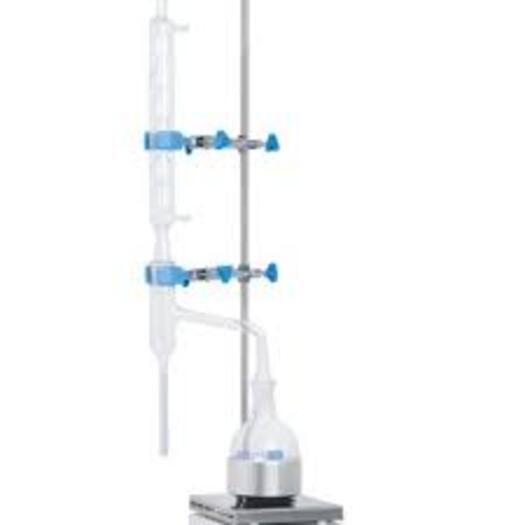
The Dean and Stark Apparatus is a specialized laboratory glassware setup used for the determination of water content in various substances through azeotropic distillation. It is widely employed in chemical, petroleum, and food industries for accurate moisture analysis, particularly in oils, bitumen, and organic compounds.
The apparatus works by separating water from a sample using an immiscible solvent, typically through reflux distillation. The collected water is then measured in a calibrated receiver, providing precise and reliable results.
Key Features:
- Accurate moisture determination by azeotropic distillation
- Made from high-quality borosilicate glass for durability and thermal resistance
- Clear and precise calibration markings
- Resistant to chemicals and high temperatures
- Easy assembly and operation
- Available in different capacities and configurations
Applications:
- Petroleum and oil testing laboratories
- Chemical and pharmaceutical industries
- Food processing and quality control
- Research and educational laboratories
- Bitumen and asphalt testing
Technical Specifications (Typical):
- Material: Borosilicate Glass
- Capacity: 5 ml, 10 ml, 25 ml receiver (customizable)
- Joint Size: Standard ground glass joints
- Method: Azeotropic distillation
- Compatibility: Suitable for organic solvents like toluene or xylene
Packaging Details:
Carefully packed in protective materials to prevent breakage during transit.
Usage Instructions:
- Assemble the apparatus with flask, condenser, and receiver.
- Add sample and solvent into the distillation flask.
- Heat the mixture to initiate distillation.
- Collect and measure separated water in the calibrated receiver.
Safety & Maintenance:
- Handle glassware carefully to avoid breakage
- Use in a well-ventilated area
- Clean thoroughly after each use
- Avoid sudden temperature changes to prevent cracking
Reliable Water Content DeterminationAccurately measure water content in oils, solvents, and emulsions using the Dean and Stark Apparatus. Engineered for laboratory chemical analysis, its borosilicate glass construction and solvent-resistant features ensure precise and repeatable results, essential for quality and compliance in testing protocols.
Flexible, Manual Operation for Every LabThe apparatus requires no electricity and is designed for ease of use on laboratory workbenches. Its versatility is demonstrated by compatibility with a range of flask volumes and receiver tube capacities. Standard joint sizes and leakproof design guarantee secure connections and straightforward sample handling.
Built to Last: Chemical and Thermal DurabilityWith high resistance to corrosion and temperatures up to 250C, this equipment supports rigorous laboratory processes. The clear graduations and chemical-resistant materials provide durability, safety, and minimal maintenance, making it a reliable tool for frequent laboratory use.
FAQ's of Dean And Stark Apparatus:
Q: How does the Dean and Stark Apparatus determine water content in samples?
A: The apparatus operates through azeotropic distillation, where the sample is heated with a suitable solvent to co-distill water. The water separates and is collected in a graduated receiver tube, allowing precise measurement of moisture content.
Q: What types of samples and chemicals can be analyzed using this apparatus?
A: It is suitable for analyzing a wide range of samples, including oils, organic solvents, and emulsions. The borosilicate glass and chemical-resistant components allow it to withstand most laboratory solvents commonly used for moisture determination.
Q: When should I select a particular receiver tube volume or flask size?
A: Receiver tube volume (2-250 ml) and flask size (100 ml-2 L) should be chosen based on your sample volume and expected water content. For higher moisture samples, larger receiver tubes and flasks are recommended to accommodate the distillation process efficiently.
Q: Where can the Dean and Stark Apparatus be used in the laboratory?
A: This apparatus is typically used on a stable benchtop setup, secured with a support stand or clamp. Its design is optimized for laboratory environments, making it ideal for research, quality control, industrial analysis, and educational laboratories.
Q: What is the process for using the Dean and Stark Apparatus?
A: After assembling the apparatus with the appropriate flask and receiver, the sample and azeotroping solvent are added. The mixture is heated (using a mantle, oil bath, or hot plate), causing water to distill and collect in the receiver, which can be read immediately via the graduated scale.
Q: What benefits does the apparatus offer over automated moisture meters?
A: The Dean and Stark Apparatus provides direct measurement, immediate visual feedback, and does not require electricity or complex calibration. Its high chemical and thermal resistance ensures reliability and minimal risk of interference from sample matrix effects.
Q: How accurate are the measurements, and how is resolution ensured?
A: With clear, finely etched graduations on the receiver tube and careful manual operation, the apparatus typically offers a measurement resolution of 0.1 ml, making it highly suitable for precise laboratory moisture determinations.

 Send Inquiry



 Send Inquiry


 Send Inquiry