Imhoff Cone 1000ml About
Product Name: Imhoff Cone
Capacity: 1000 ml
Material: Borosilicate Glass / Plastic
Application: Sedimentation Analysis, Wastewater Testing
Usage: Laboratory / Industrial
Product Description:
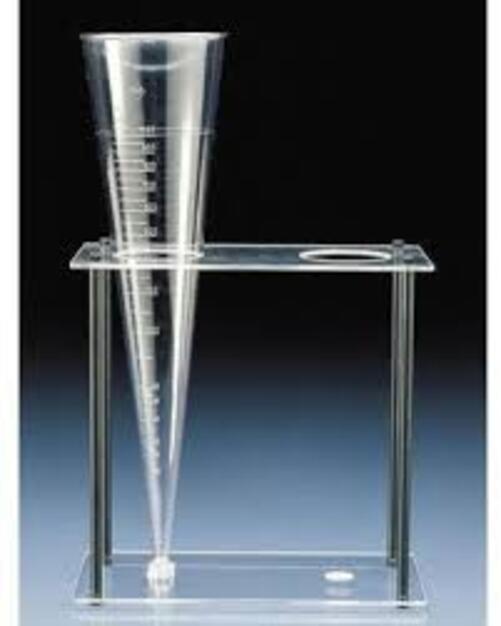
Imhoff Cone (1000 ml) is a laboratory apparatus used for determining the volume of settleable solids in water and wastewater. It is widely used in environmental and sewage analysis. The cone is graduated up to 1000 ml with precise markings for accurate sedimentation readings. It may be made of borosilicate glass or durable plastic and is often supplied with a stand or stopcock for easy handling and cleaning.
Precision in Water and Wastewater TestingEngineered for accurate measurement, the Imhoff Cone is essential for settleable solids determination in environmental and industrial laboratories. The conical shape enables reliable sedimentation analysis, ensuring robust and repeatable results. Its transparent borosilicate glass construction allows for clear visibility and precise readings.
Durability and ReusabilityManufactured from borosilicate glass, the Imhoff Cone offers excellent resistance to chemical corrosion and high temperatures. Autoclavable and reusable, it ensures longevity and cost-effectiveness for laboratories handling routine and rigorous testing, while adhering to key international standards.
Easy Handling and Versatile ApplicationWith a user-friendly graduated scale and a sturdy, closed base design, this 1000ml cone accommodates diverse analytical workflows. Its dimensions (approx. 420 mm height and 110 mm base diameter) enable stable, safe placement during test processes, making it suitable for a broad spectrum of environmental monitoring applications across India.
FAQ's of Imhoff Cone 1000ml:
Q: How is the Imhoff Cone 1000ml used in settleable solids determination?
A: To determine settleable solids, water or wastewater samples are poured into the Imhoff Cone up to the pre-marked 1000 ml graduation. The sample is left to settle undisturbed, typically for one hour, and the volume of accumulated solids in the tip of the cone is then read directly from the graduated scale.
Q: What are the advantages of using borosilicate glass for the Imhoff Cone?
A: Borosilicate glass brings superior resistance to acids, alkalis, and thermal shock, withstanding temperatures up to 250C. This ensures durability, frequent autoclaving, and reliable reusability for laboratory environments handling aggressive chemicals or requiring sterilization.
Q: When should the Imhoff Cone be autoclaved, and how does this benefit users?
A: The cone should be autoclaved before or after use to maintain sterility, especially when used in microbiological or regulated analyses. Autoclaving benefits users by eliminating contaminating agents, supporting precise and uncontaminated results during repetitive or sensitive testing.
Q: Where can the Imhoff Cone 1000ml be used for sample analysis?
A: It is ideal for use in environmental monitoring laboratories, municipal and industrial wastewater treatment plants, and research institutions across India where compliance with ISO 5667-1 and ASTM D1889 is required.
Q: What process ensures accurate measurement using this cone?
A: Using the cone's clear, 10 ml interval graduations, samples are measured by filling to the desired mark and allowing solids to settle. The transparent cone and precise graduations allow direct reading of settled volume with minimal error, enhancing analytical accuracy.
Q: What are the main benefits of the cone's conical and closed base design?
A: The conical shape facilitates optimal settling of solids at the pointed tip, while the closed base enhances stability and safety during handling. This design improves measurement precision and reduces the risk of spillage or sample loss.

 Send Inquiry



 Send Inquiry


 Send Inquiry