Three Gang Prism Mould About
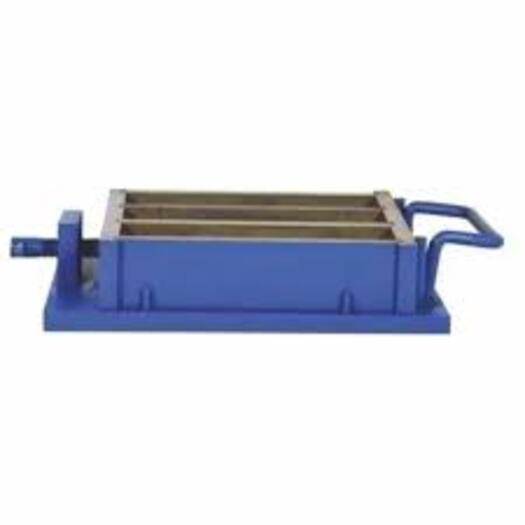
The Three Gang Prism Mould is a precision laboratory mould used for preparing standard cement mortar prism specimens for flexural and compressive strength testing. It is widely used in construction material testing laboratories to ensure accurate and uniform specimen preparation as per standard testing procedures.
This mould is manufactured using high-quality cast iron or mild steel, ensuring excellent strength, rigidity, and long service life. It is designed to cast three prism specimens simultaneously, improving efficiency in laboratory testing operations. The precision-machined inner surfaces ensure accurate dimensions and smooth finishing of test specimens.
The robust construction and accurate alignment of the mould make it suitable for repeated laboratory use, ensuring consistent and reliable test results.
Key Features:
- Heavy-duty cast iron / mild steel construction
- Precision-machined for accurate prism dimensions
- Capable of casting three specimens at a time
- Corrosion-resistant and durable design
- Easy assembly and dismantling
- Ensures uniform and smooth specimen formation
Applications:
- Cement and mortar testing laboratories
- Civil engineering quality control departments
- Construction material testing facilities
- Research and development laboratories
- Academic and training institutions
Working Principle:
The mould is filled with cement mortar and compacted properly to form three standard prism specimens. After curing, these specimens are used for flexural and compressive strength testing to evaluate cement quality.
Durable Construction & High PrecisionEngineered from heavy-duty, chrome-plated steel, the Three Gang Prism Mould stands out for its exceptional durability and resistance to corrosion. Precision machining ensures that each specimen produced meets strict dimensional accuracy, making it ideal for precise laboratory analyses. Its robust build provides long-term reliability, even under rigorous usage in demanding environments.
Easy Operation & DemouldingDesigned with user convenience in mind, the prism mould features a detachable base, enabling effortless removal of specimens without risk of damage. The manual operation requires no power supply, making it suitable for various laboratory settings. All included accessories (base plate, partitions, and end plates) streamline the preparation process, ensuring efficient specimen casting every time.
Compliance with International StandardsThis prism mould complies with major international standards such as IS 4031, ASTM C109, and BS 1881. It is purpose-built for preparing 40 mm x 40 mm x 160 mm cement and mortar prisms, matching testing protocols worldwide. Users benefit from assured compatibility and repeatable results, essential for quality assurance and product certification in the construction industry.
FAQ's of Three Gang Prism Mould:
Q: How do I use the Three Gang Prism Mould for preparing specimens?
A: To use the Three Gang Prism Mould, assemble all supplied components (base plate, partition plates, and end plates), ensuring tight-fitting joints. Pour the prepared cement or mortar mixture into each chamber, compact according to the test standard, smooth the surface, and allow the material to set. The detachable base allows easy removal of specimens once cured.
Q: What materials and features ensure the mould's durability and accuracy?
A: The mould is manufactured from high-grade, heavy-duty steel with a smooth, corrosion-resistant chromium-plated finish. Precision machining delivers highly accurate specimen dimensions, while the rigid construction ensures long-term durability in laboratory conditions.
Q: When should I choose this mould over other mould types?
A: Select the Three Gang Prism Mould when you need to prepare standard cement and mortar prisms for compression or flexural strength testing, in accordance with IS 4031, ASTM C109, or BS 1881. Its three-compartment design enables simultaneous preparation of multiple specimens, increasing efficiency in laboratory testing workflows.
Q: Where can the Three Gang Prism Mould be mounted or used?
A: This equipment is suitable for bench-top installation and is portable, making it versatile for use in a variety of laboratory settings-including on-site construction material testing labs and educational institutions.
Q: What process ensures easy demoulding of specimens?
A: The detachable base is specifically designed to facilitate effortless demoulding. After curing, simply detach the base to release the specimens without causing any dimensional deformation or surface defects.
Q: What are the main benefits of using the Three Gang Prism Mould?
A: Key benefits include precision in specimen dimensions, corrosion resistance, user-friendly operation, easy demoulding, and compliance with international standards. Its robust, maintenance-free design contributes to accurate, reliable, and repeatable test results, essential for construction material quality control.

 Send Inquiry




 Send Inquiry


 Send Inquiry