Torsion Testing Machine About
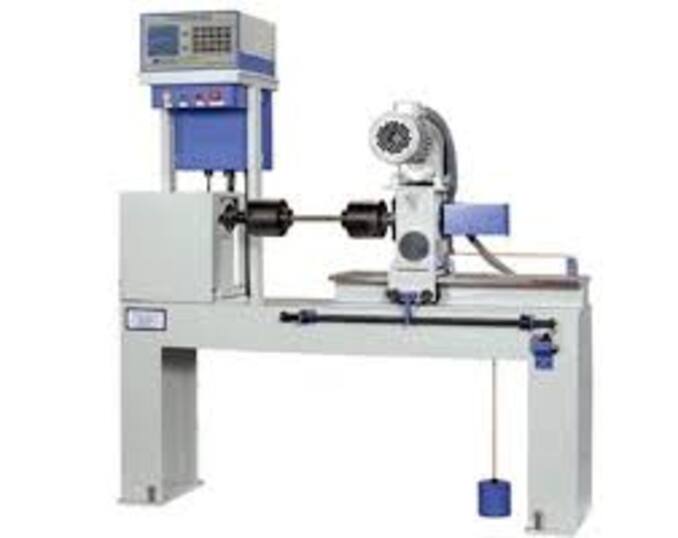
A Torsion Testing Machine is a precision laboratory instrument used to determine the torsional strength, shear strength, and rigidity of materials such as metals, wires, rods, bars, and shafts. It evaluates how a material behaves when subjected to a twisting (torque) force until failure or deformation.
This machine is widely used in mechanical engineering laboratories, metallurgical industries, automotive sectors, research institutions, and quality control departments for material performance analysis and design validation.
Key Features
- High-accuracy torque measurement system
- Digital / analog torque indicator (model dependent)
- Rigid and vibration-free heavy-duty frame
- Smooth and controlled application of torsional load
- Adjustable specimen holding chucks
- Forward and reverse loading capability
- Safety shield for operator protection
- Suitable for a wide range of specimen sizes
Working Principle
The machine applies a gradually increasing twisting force (torque) to a specimen fixed at both ends. As torque increases, the material undergoes angular deformation until it yields or fractures. The machine records the torque vs. angle of twist, helping determine mechanical properties such as modulus of rigidity and shear strength.
Applications
- Testing of shafts, wires, rods, and fasteners
- Automotive and aerospace component testing
- Material research and development
- Quality control in manufacturing industries
- Mechanical and civil engineering laboratories
- Educational training and experiments
Advantages
- Provides accurate torsional strength analysis
- Essential for designing rotating machine parts
- Helps evaluate material behavior under twisting loads
- Simple and reliable operation
- Suitable for both academic and industrial use
Technical Specifications (Typical)
- Torque capacity: As per model (e.g., 10 Nm to 2000 Nm)
- Angle of twist measurement: Digital encoder / dial gauge
- Specimen length: Adjustable support system
- Operation: Manual / motorized loading system
- Accuracy: High precision torque measurement
Versatile Applications for Multiple SectorsTailored for metallurgical labs, research institutions, and educational organizations, this torsion testing machine is adept at analyzing material properties under twisting forces. Its wide application scope supports routine testing, academic demonstrations, and advanced material research, making it indispensable in quality control and R&D environments.
Precision Engineering and ConvenienceConstructed with mild steel and a rigid, heavy-duty frame, the machine guarantees durability and operational stability. Choose between manual and motorized operations to suit testing demands. The machine's adjustable fixtures accommodate various specimen geometries, and its digital or mechanical counter ensures reliable data collection.
FAQ's of Torsion Testing Machine:
Q: How is the torsion testing process carried out using this machine?
A: The specimen, whether round or flat, is securely clamped within the machine's adjustable fixtures. Depending on the model (manual or motorized), torque is applied to twist the specimen. The resulting force and angle of twist are measured precisely, using either digital or mechanical counters, to determine the material's torsional properties.
Q: What types of specimens can be tested with this machine?
A: This torsion testing machine supports both round and flat bar specimens with diameters up to 12 mm. The adjustable clamping system allows easy fitting and secure holding during testing, offering flexibility for various material types.
Q: When should I use the motorized operation over manual?
A: Motorized operation is ideal when consistent and controlled rotation is required, such as for repetitive tests or when testing requires precise speed (up to 2 RPM). Manual mode is suitable for individual tests or hands-on instruction, especially in educational settings.
Q: Where is this torsion testing machine commonly used?
A: The machine is widely used in metallurgical laboratories, research institutes, and educational institutions across India. Its rugged design and precision features make it a preferred choice for quality assurance, academic demonstration, and research applications.
Q: What are the main benefits of using this torsion testing machine?
A: Key benefits include accurate torque measurement (with 1% FSD accuracy), adaptability to different specimen shapes and sizes, user-friendly operation, and a durable build for long-term reliability. It enhances the study and analysis of material behaviors under torsional loads, boosting efficiency in labs and classrooms.
Q: How does the machine ensure measurement accuracy during tests?
A: The machine uses high-quality torque sensors, with measurements displayed in Nm or kgfm, and offers a full-scale deflection accuracy of 1%. The rigid frame construction minimizes vibration, aiding precise and repeatable results.

 Send Inquiry


 Send Inquiry


 Send Inquiry